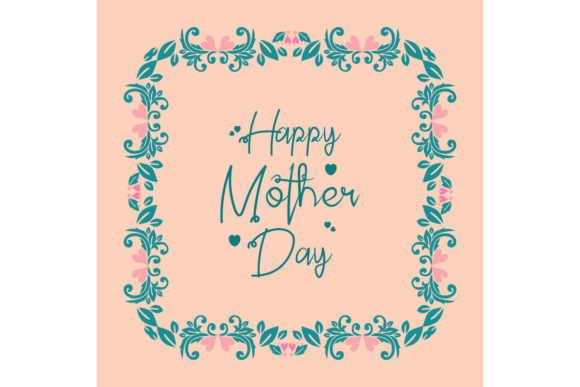
Evaluating Happy Mother Day Greeting Card Design with Ornate Floral and Leaf Frames
Selecting the right visual identity for Mother’s Day requires balancing emotional resonance with professional aesthetics. When researching options, a Happy Mother Day greeting card design featuring beautiful ornate leaf and floral frames consistently emerges as a versatile standard. This specific style combines traditional botanical illustration with structured vector geometry, offering a distinct alternative to both minimalist typography and photorealistic imagery. For designers, marketers, and individuals comparing resources, understanding the technical and aesthetic nuances of this category is essential for making an informed choice.
This design approach is defined by its use of scalable vector graphics (SVG) to render intricate natural elements. Unlike raster-based photographs or hand-painted watercolors, vector illustrations allow for infinite resizing without quality loss. The "ornate frame" component serves a dual purpose: it provides a decorative border that signals celebration and creates a dedicated negative space for personalized messaging. When evaluating this style against other market options, the primary differentiator is its adaptability across print and digital mediums while maintaining a classic, timeless appeal that avoids looking dated.
Distinguishing Vector Botanical Styles from Alternatives
To determine if an ornate floral vector frame is the correct asset, it must be weighed against competing design categories. Each style carries different implications for production, customization, and audience reception.
Vector Illustration vs. Raster Photography
Photographic cards offer immediate emotional impact through human connection but present significant limitations in editing. A photograph has fixed lighting, resolution, and composition. In contrast, a Happy Mother Day greeting card design built on vectors allows users to modify individual elements. If a leaf overlaps with text in a raster image, removing it requires complex cloning tools. In a vector file, the user simply deletes or moves the node. Furthermore, vectors maintain crisp edges at any size, making them superior for large-format printing like posters or banners, whereas photos may pixelate when scaled beyond their native resolution.
Ornate Frames vs. Minimalist Typography
Minimalist designs rely heavily on font hierarchy and whitespace. While modern and clean, they can sometimes feel impersonal or corporate for a holiday centered on warmth and affection. Ornate floral frames introduce organic texture and softness that typography alone cannot achieve. However, minimalism offers faster readability. The tradeoff with ornate designs is visual density; if the frame is too busy, it competes with the message. Successful evaluation involves checking the balance between the decorative border and the central copy area. High-quality vector assets typically separate these layers, allowing users to reduce opacity or simplify the frame if the default ornamentation feels overwhelming.
Botanical Vectors vs. Hand-Drawn Watercolor
Watercolor styles convey authenticity and artisanal craftsmanship. They are often perceived as more "human." However, watercolor scans are raster images with transparent backgrounds that can be difficult to color-match or edit. Vector interpretations of florals offer the same organic aesthetic with mathematical precision. For commercial projects requiring brand color consistency, vectors are objectively superior because colors are defined by hex codes rather than pixel values. For personal, one-off gifts where imperfection is desired, watercolor may be preferable. For scalable, editable, and reproducible projects, vector botanicals provide greater utility.
Technical Considerations and File Format Evaluation
When sourcing a Happy Mother Day greeting card design, the file format dictates future usability. Not all vector files are created equal, and understanding these distinctions prevents workflow bottlenecks.
- AI (Adobe Illustrator): The industry standard for editing. Best for users who need to reshape curves, adjust anchor points, or completely redesign the frame structure. Requires specialized software and skill.
- EPS (Encapsulated PostScript): A universal vector format compatible with most design software, including CorelDRAW and Affinity Designer. Ideal for cross-platform compatibility but may lose some advanced Illustrator-specific effects.
- SVG (Scalable Vector Graphics): Web-native and lightweight. Essential for digital e-cards, email newsletters, or web-based greeting platforms. Limited support for complex gradients compared to AI/EPS.
- PDF (Vector-based): Excellent for direct-to-print workflows. Preserves vector data while being universally viewable. Less suitable for deep editing but perfect for final output verification.
A critical decision factor is layer organization. Poorly constructed vector assets group all elements into a single locked layer, rendering them nearly useless for customization. Before acquiring a resource, verify that the floral frame, background, and text placeholders are on separate, labeled layers. This structural integrity determines whether the asset is a flexible template or merely a static decoration.
Assessing Fit: When Ornate Floral Vectors Are the Right Choice
This design style excels in specific contexts but falls short in others. Evaluating fit prevents misalignment between the asset and the project goal.
Ideal Use Cases
Commercial Print Products: For businesses producing greeting cards, gift tags, or packaging, ornate vector frames offer the highest return on investment. One asset can be recolored to create multiple SKUs (e.g., pink roses for general Mother’s Day, purple lavender for grandmothers). The scalability ensures the same design works for a 4x6 card and a storefront window decal.
Brand-Aligned Communications: Organizations sending corporate appreciation notes need visuals that feel warm yet professional. Abstract art can be confusing; photos can raise privacy or licensing issues. Botanical vectors occupy a safe middle ground—universally positive, non-controversial, and easily adapted to match corporate color palettes.
DIY Customization Projects: For users with intermediate design skills using tools like Canva or Illustrator, these templates provide a professional foundation without requiring illustration expertise. The pre-drawn ornate elements save hours of drafting time while still allowing for personal text and photo insertion within the frame.
Situations Requiring Alternative Approaches
Ultra-Modern or Tech-Focused Audiences: If the recipient demographic skews toward Gen Z or prefers avant-garde aesthetics, traditional ornate florals may read as old-fashioned. In such cases, geometric abstraction or bold typographic treatments may resonate better.
Rapid Social Media Content: While vectors can be exported for social media, the intricate details of ornate frames often get lost on small mobile screens. Simple, high-contrast graphics typically perform better in feed environments where users scroll quickly. Ornate designs require larger viewing areas to be appreciated.
Budget-Constrained One-Time Use: If the need is for a single personal card with no intention of reuse or editing, purchasing a premium vector asset is inefficient. A ready-made physical card or a free raster template would be more economically rational. Vector assets justify their cost through reusability and editability.
Navigating Tradeoffs and Quality Indicators
No design resource is without compromise. Understanding the inherent tradeoffs of Happy Mother Day greeting card design with ornate frames helps manage expectations.
Complexity vs. Editability: Highly detailed ornate frames with hundreds of leaves and petals look stunning but can be computationally heavy and tedious to edit. Simplifying such designs requires deleting numerous anchor points, which risks altering the intended aesthetic. Conversely, simpler frames are easier to manipulate but may lack the luxurious feel associated with "ornate." Users must decide where they fall on this spectrum based on their technical proficiency and hardware capabilities.
Tradition vs. Originality: Floral frames are a established trope. The risk is creating something generic. To mitigate this, evaluate assets that offer unique botanical species or unconventional colorways rather than standard red roses. Alternatively, choose templates where the frame components are modular, allowing you to rearrange elements into a custom composition that differs from the stock preview.
Licensing Clarity: Vector assets come with varying license terms. Some permit unlimited commercial reproduction; others limit print runs or prohibit use in products for resale. Always review the specific license agreement. A cheaper asset with restrictive terms may ultimately cost more if it necessitates repurchasing for broader usage. For commercial greeting card lines, ensure the license explicitly covers "print-on-demand" or "merchandise" if applicable.
Making the Final Selection
The decision to utilize a vector-based ornate floral frame should stem from a clear assessment of project requirements. Prioritize assets that demonstrate clean path construction, logical layer separation, and appropriate licensing for your intended use. Compare at least three options side-by-side, testing each for color customization ease and text integration flexibility. Remember that the most visually impressive preview image does not always translate to the most functional working file. By focusing on technical viability alongside aesthetic appeal, you can select a Happy Mother Day greeting card design that serves both immediate needs and long-term creative goals. This balanced approach ensures the final product honors the occasion with beauty while respecting practical constraints of time, budget, and production capability.