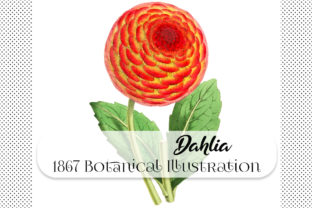
Integrating the Botanical Dahlia Flower into Modern Creative Workflows
In the landscape of digital design and content creation, sourcing high-quality visual assets that balance historical authenticity with modern usability is a frequent operational challenge. The Botanical Dahlia Flower illustration, specifically the "Flambeau" variety from an 1867 floral compendium, represents a strategic solution for professionals seeking public domain imagery without the friction of extensive post-production. This asset bridges the gap between archival research and contemporary application, offering a pre-processed, copyright-free element that streamlines the creative pipeline. Understanding how to leverage this specific type of botanical art requires looking beyond its aesthetic value to appreciate its role in efficient project execution.
The Strategic Value of Pre-Processed Vintage Assets
For marketers, educators, and designers, time allocation is often more critical than raw artistic skill. While scanning original 19th-century plates yields unique results, the restoration process can consume hours of billable time or personal energy. This particular Botanical Dahlia Flower asset eliminates the technical barriers associated with antique ephemera. The image has already undergone color correction to heighten vibrancy while retaining the organic texture of the original lithograph. More importantly, it arrives as a cutout, removing the tedious background extraction phase that typically bottlenecks workflow when using vintage source material.
This readiness transforms the asset from a mere reference image into a functional design component. In professional environments where turnaround times are tight, having a PNG file with transparency allows for immediate layering in composite projects. Simultaneously, the included JPG serves lighter use cases such as web backgrounds or document headers where alpha channels are unnecessary. By providing both formats, the asset supports diverse output requirements without forcing the user to convert files or manage multiple versions manually.
Navigating Copyright and Commercial Safety
One of the primary risks in commercial creative work is intellectual property uncertainty. Using images found via general search engines often exposes businesses and freelancers to licensing ambiguities. Because this Flambeau dahlia originates from a publication dated 1867, it resides firmly in the public domain. This legal status provides a safe foundation for a wide array of applications, from merchandise production to corporate branding. For entrepreneurs and small business owners, this certainty removes the need for legal review or royalty tracking, allowing resources to be redirected toward product development and marketing strategy rather than compliance management.
Implementation Across Project Phases
The utility of the Botanical Dahlia Flower extends across the entire lifecycle of a creative or educational project. Its application is not limited to final decoration but can influence planning, execution, and post-production refinement.
Pre-Production and Mood Boarding
During the conceptualization phase, visual anchors help align stakeholder expectations. This dahlia illustration serves as an effective tonal reference for projects requiring a blend of classic elegance and modern clarity. When building mood boards for wedding stationery, heritage brand identities, or seasonal packaging, dropping this high-resolution cutout into Pinterest boards or Figma files establishes a concrete visual language. The heightened colors provide a clear indication of the intended palette, while the vintage line work communicates texture and style. This reduces abstract discussions about "vintage vibes" and replaces them with tangible visual benchmarks.
Active Design and Composition
In the execution phase, the asset functions as a versatile structural element. Graphic designers can utilize the transparent PNG to create depth in layered compositions. For example, placing the dahlia behind typography but in front of a solid color block creates an immediate sense of dimension without complex shadow rendering. Educators creating course materials can use the flower as a consistent visual motif to denote specific modules or breaks in text, improving information retention through visual association. Bloggers and social media managers can overlay text directly onto the negative space surrounding the petals, ensuring readability while maintaining thematic consistency.
Post-Production and Asset Repurposing
Efficiency also dictates how assets perform after the initial project launch. A high-quality Botanical Dahlia Flower cutout retains value across multiple campaigns. Once integrated into a primary design system, the same file can be resized for email signatures, adapted for thank-you cards, or used as a watermark overlay. The lack of background artifacts ensures that repurposing does not require re-editing. For print-on-demand sellers, the resolution and color fidelity support scaling for various product sizes, from phone cases to wall art, maximizing the return on the time invested in selecting the asset.
Technical Integration and Workflow Compatibility
Seamless integration depends on understanding the technical characteristics of the file and how it interacts with standard industry tools. While the image is ready to use, optimizing its implementation ensures consistent quality across different media.
- Color Space Management: The heightened colors mentioned in the asset description are ideal for RGB screens. However, professionals preparing this Botanical Dahlia Flower for print should verify color profiles. Converting the vibrant digital colors to CMYK may result in slight shifts; performing a soft proof before finalizing print files prevents unexpected dullness in the reds and oranges characteristic of the Flambeau variety.
- Resolution Scaling: As a raster image derived from a physical plate, there is a limit to how much the file can be enlarged before pixelation occurs. For large-format printing, consider using AI upscaling tools or vectorization software to trace the edges if infinite scalability is required. For standard web and editorial use, the native resolution typically suffices.
- Layer Organization: When importing the PNG into Photoshop, Illustrator, or Canva, maintain organized layer naming conventions. Labeling the layer "Dahlia_Flambeau_1867_PD" helps future collaborators identify the source and licensing status immediately, preventing accidental replacement with copyrighted alternatives during team handoffs.
- Texture Preservation: The imperfections in the fine details are noted as adding vintage character. Avoid applying aggressive smoothing filters or noise reduction that might sterilize the image. The grain and slight ink bleed are features, not flaws, that distinguish this asset from generic AI-generated florals.
Quality Control and Consistency Standards
Maintaining a cohesive visual identity requires treating public domain assets with the same rigor as custom photography. When incorporating the Botanical Dahlia Flower into a broader design system, establish guidelines for its usage. Define acceptable color overlays, minimum clear space around the illustration, and prohibited modifications that might distort its historical integrity. For brands using multiple botanical illustrations, ensure that the color grading of this dahlia matches other assets in the collection. Even though individual plates from 1867 vary in saturation, post-processing should harmonize them to present a unified front to the audience.
Consistency also applies to metadata and file management. Embedding relevant keywords and attribution notes (even if not legally required) within the file properties aids in long-term asset retrieval. A well-organized digital asset management (DAM) system ensures that six months from now, when a similar campaign arises, the team can locate this specific Flambeau dahlia without sifting through hundreds of unlabelled flower images.
Enhancing Productivity Through Curated Resources
Ultimately, the decision to use a prepared Botanical Dahlia Flower illustration is a productivity calculation. It represents a shift from resource generation to resource curation. For freelancers billing by the project, reducing asset preparation time by two hours directly improves profit margins. For educators, it means spending less time fixing scan lines and more time developing curriculum. For hobbyists, it lowers the barrier to entry for creating professional-looking scrapbooks or journals.
The intersection of historical beauty and modern convenience makes this asset particularly valuable. It respects the craftsmanship of 19th-century botanical artists while acknowledging the practical realities of 21st-century workflows. By handling the restoration, isolation, and formatting beforehand, this resource allows creators to focus on what they do best: storytelling, teaching, selling, and designing. Whether used as a focal point in a luxury packaging design or a subtle accent in a digital newsletter, the Flambeau dahlia demonstrates that efficient workflows and rich aesthetics are not mutually exclusive. Integrating such assets thoughtfully ensures that projects are not only visually compelling but also operationally sound and legally secure.